
Scindapsus Blue Albo
Introduction
Variegation fascinates.
Leaves splashed with white, marbled with cream, streaked with irregular lines that look almost hand-painted. In recent years, these unpredictable patterns have become iconic in the world of tropical plants.
But behind this spectacular aesthetic lies a much more nuanced reality. Variegation is not a “decorative bonus.” It’s a mutation.
And like any mutation, it comes with trade-offs. Less chlorophyll means less energy. Less energy means a more fragile balance.
And sometimes, it leads to a phenomenon many collectors fear: reversion.
In this article, we’re not focusing on a specific species. We’re exploring a plant behavior.
Through three very real cases at LFAP — a Philodendron hederaceum Albo, a Scindapsus Blue Albo, and a Philodendron Rio — we explore what truly happens when a variegated plant begins to change.
Because a plant isn’t trying to be beautiful. It’s trying to survive.
Variegation 101 : comprendre ce qui se passe vraiment
Variegation refers to the presence of multiple colors on the same plant—most often green combined with white, cream, or yellow. This contrast is caused by a mutation that affects chlorophyll production.
Chlorophyll is the pigment responsible for photosynthesis. It allows the plant to convert light into energy. The white or cream areas of a leaf contain little to no chlorophyll.
They’re beautiful… but they don’t contribute to energy production.
In other words: the more variegated a plant is, the less energy-efficient it becomes.
That’s where the balance gets interesting.
A highly variegated plant can survive and even thrive if:
- the light is adequate,
- the stem structure maintains active green tissue,
- and the proportion of white remains viable.
But if the plant’s energy balance becomes too fragile, it may trigger a natural mechanism: producing more green tissue. That’s what we call reversion.
Reversion is not a disease. It’s not a defect. It’s a survival reflex. The plant is simply trying to increase its photosynthetic capacity.
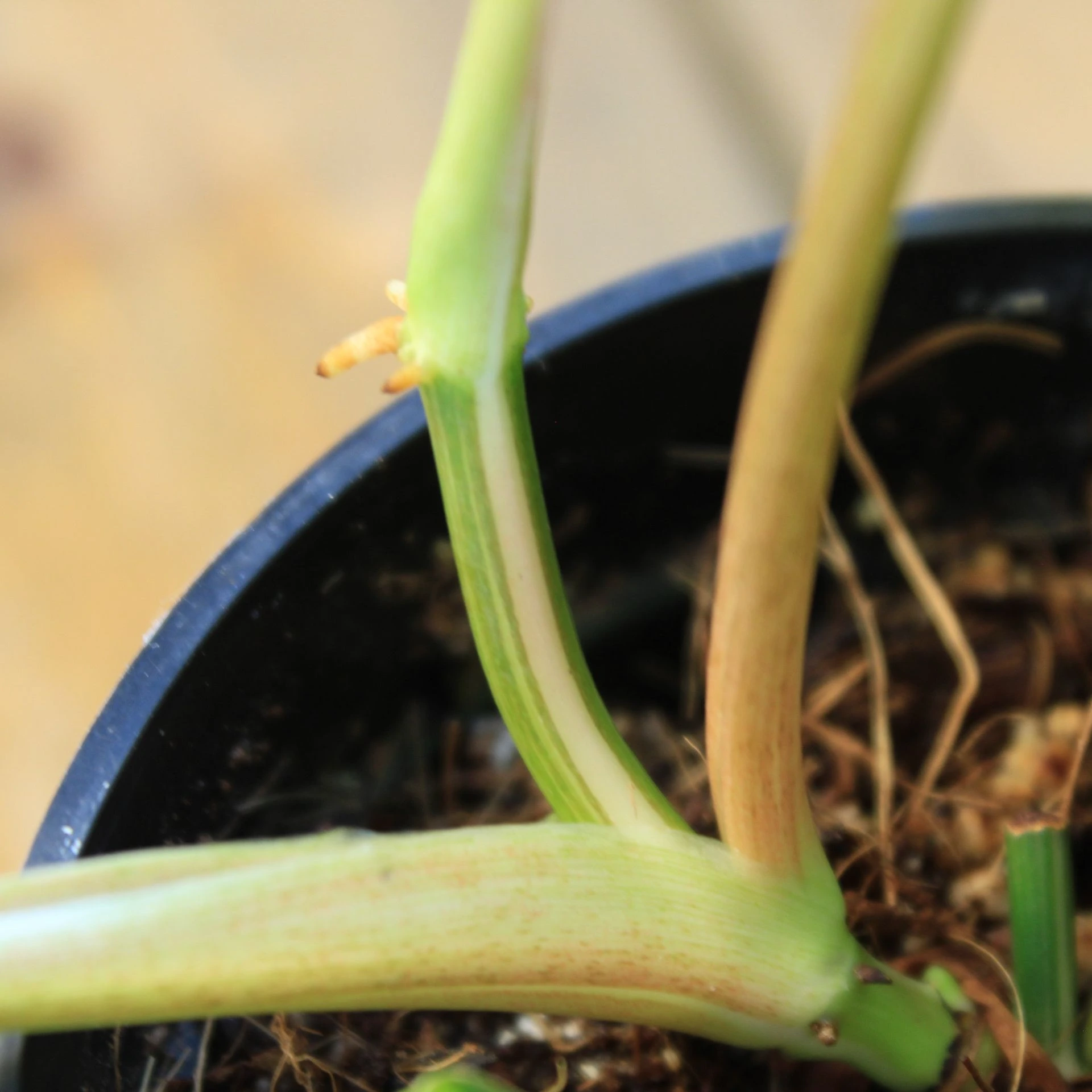
And that’s where observation becomes essential. Because variegation isn’t read only on the leaf — it’s read primarily in the stem.
Real Case #1 — Philodendron hederaceum Albo
When You Adopt… and Reversion Strikes Quickly
I didn’t grow this plant from the beginning. I adopted it as a mid-cut, with only two leaves. Two beautiful variegated leaves. Promising.
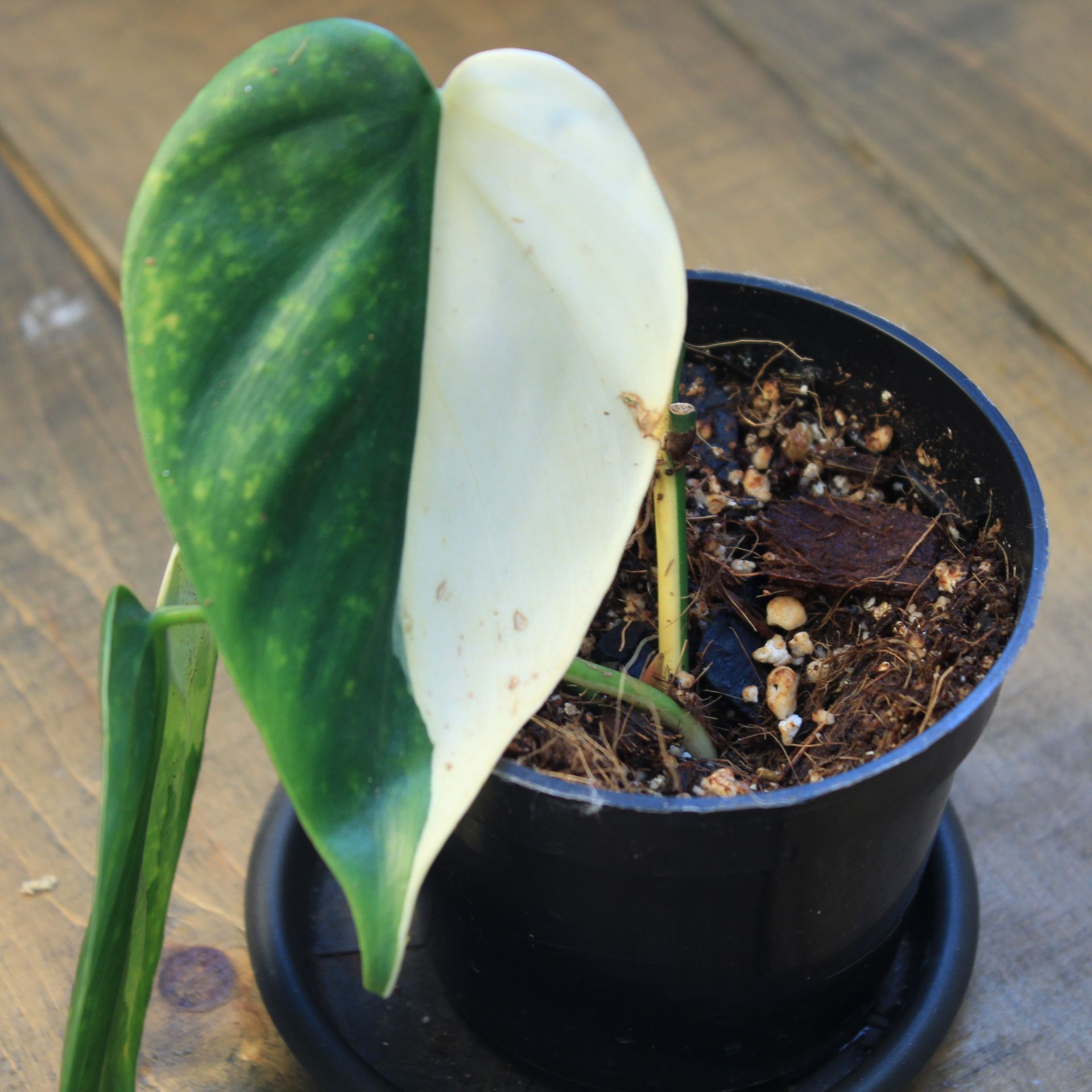
The potential was there. Then the next two leaves emerged… and they had reverted. Greener. Much greener.
The kind of moment when you just stare at the plant in silence.
What That Meant
When a plant grown from a mid-cut starts producing green growth quickly, it often indicates that the active portion of the stem is dominated by green tissue.
And in my case, I didn’t have much room to maneuver. I couldn’t cut below the first two variegated leaves. Cutting any lower would have compromised the plant.
So I made the only cut possible: between the two older variegated leaves and the two newer reverted leaves.
Logically, the remaining stem should produce more green growth. Biologically, that makes sense.
But here’s the twist.
After making the cut… a leaf emerged from a node almost at soil level. A new activation. A new attempt. And suddenly, hope returns.
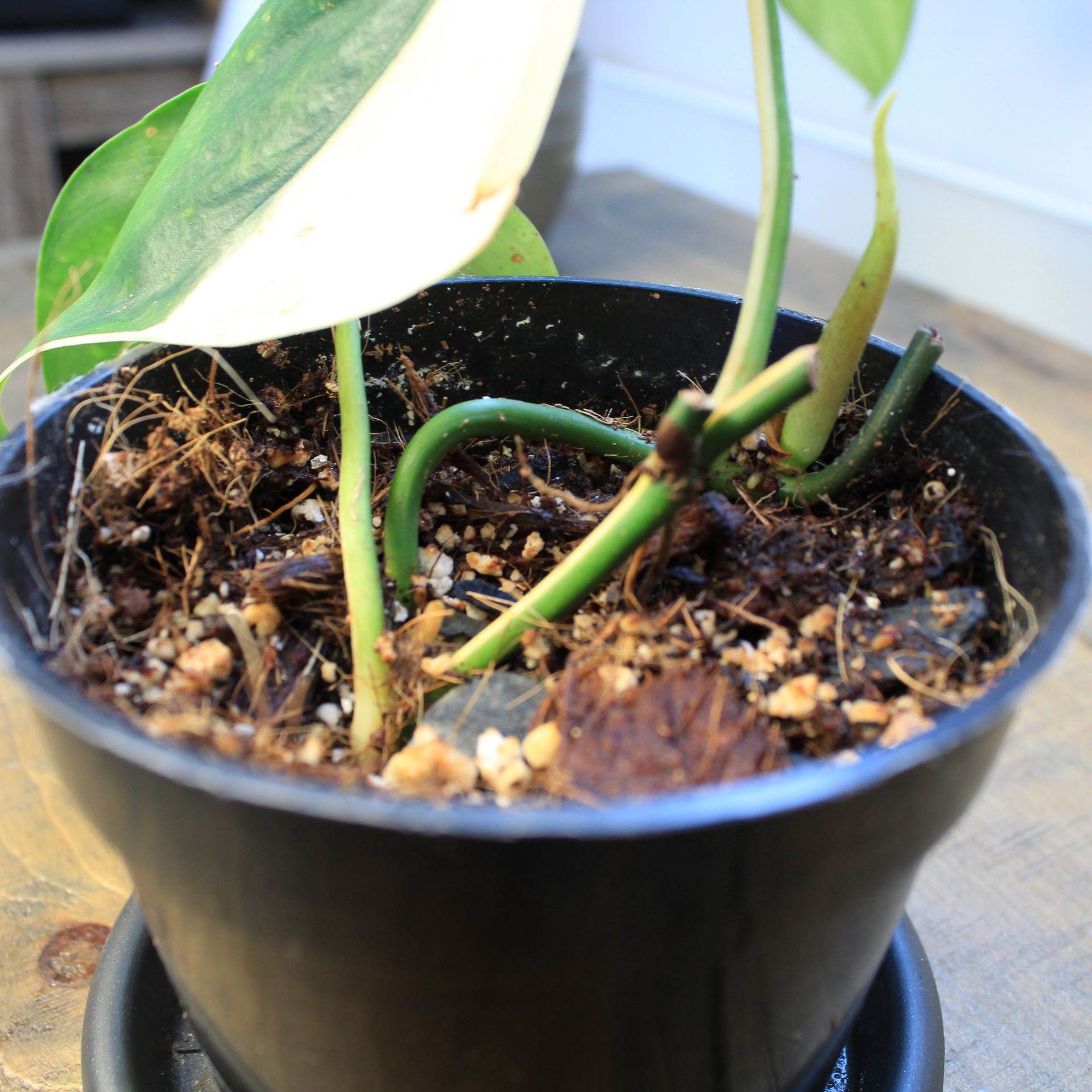
Because that node comes from the plant’s original section — the one that was variegated.
Nothing is guaranteed. But the likelihood of a better distribution of white is real.
What This Case Illustrates
Variegation isn’t always linear. A stem can shift toward green.
But a lower node may still carry the mutation in a different way. That’s why every cut is strategic.
And that each node tells a different story.
Real Case #2 — Scindapsus Blue Albo
The All-White Leaf: Aesthetic Dream or Warning Sign?
There’s something almost unreal about an entirely white leaf. Not marbled. Not splashed. Completely white.
My Scindapsus Blue Albo gave me exactly that.
Visually? Spectacular.
Biologically? Much more nuanced.
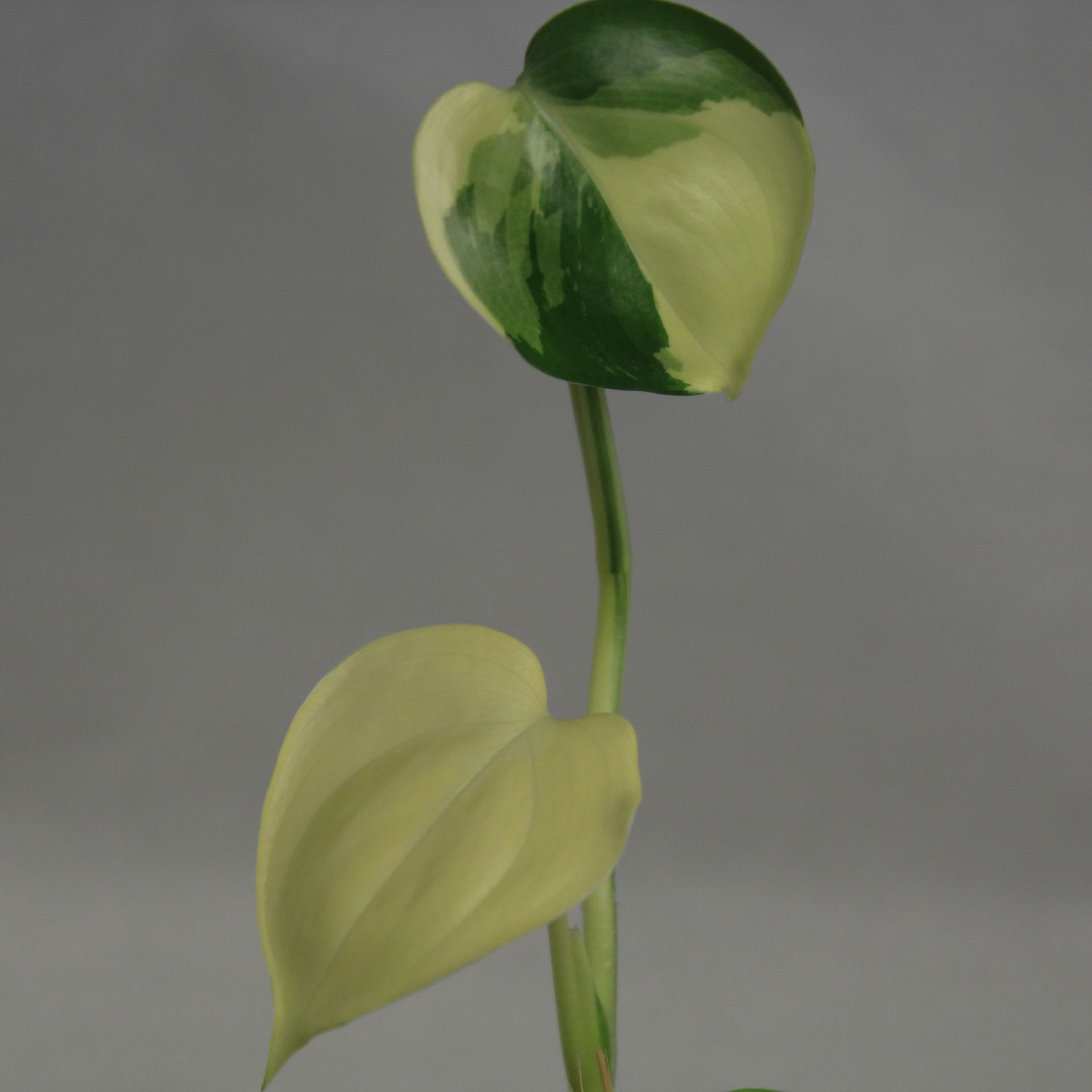
A white leaf does not produce energy.
A leaf without chlorophyll does not participate in photosynthesis. It lives off the other leaves. It depends on the existing structure. That’s why a plant that produces leaf after leaf that is entirely white can eventually exhaust itself.
But in my case, I don’t just look at the leaf. I look at the stem.
Reading the Stem: The True Indicator
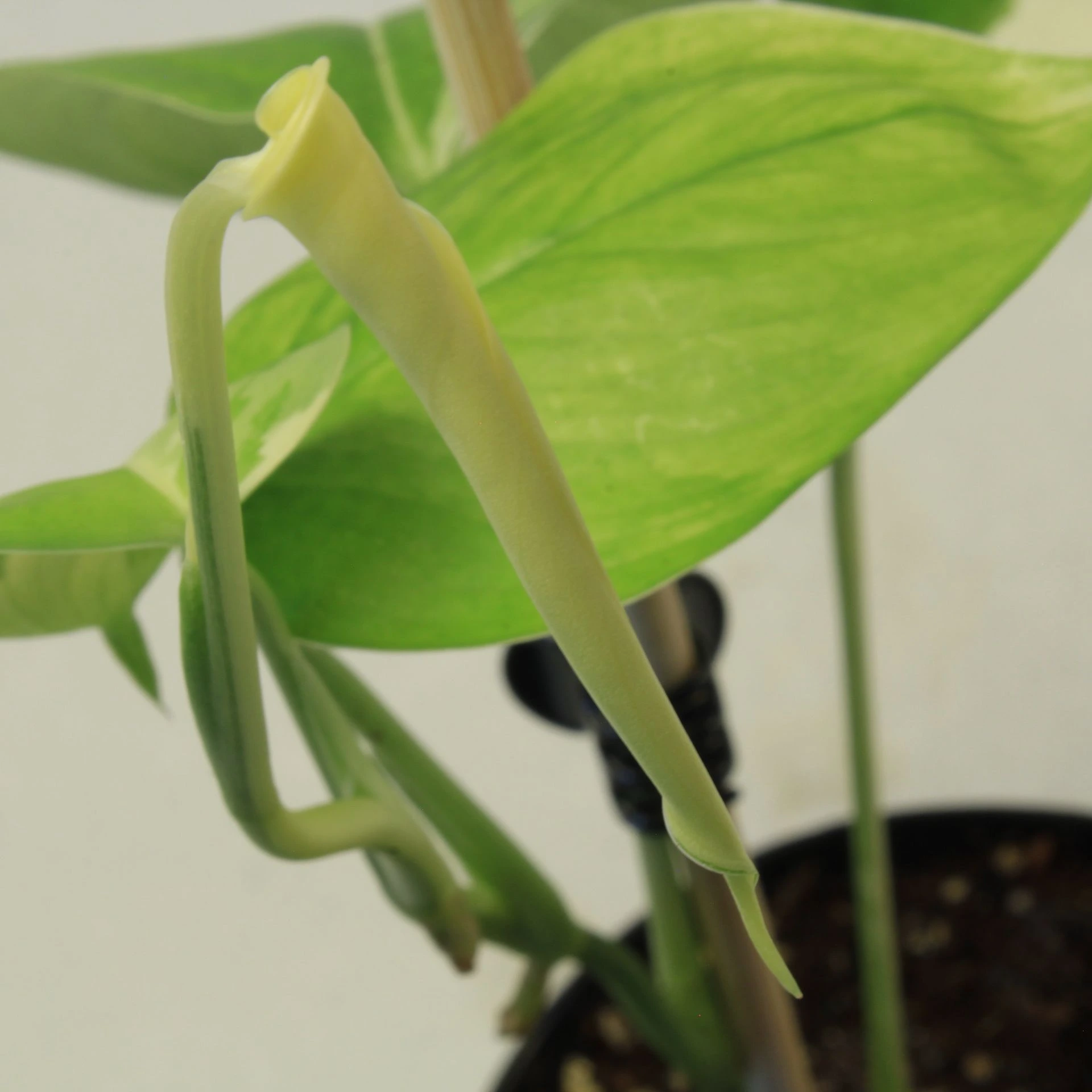
On my Scindapsus, even though the leaf is white, the stem still clearly shows green. And that’s what’s reassuring.
The mutation hasn’t eliminated the plant’s photosynthetic capacity in its main structure. The plant retains a viable energy base.
In other words: a white leaf can be a spectacular moment. It’s not automatically a death sentence.
The Fragile Balance
If the next leaves also emerge entirely white, then we may need to step in.
But as long as the stem shows a balanced mix of green and variegated tissue, we observe.
Variegation is a dance between aesthetics and survival. And sometimes, the plant flirts with the edge.
Real Case #3 — Philodendron Rio
Progressive Reversion: When It Happens Slowly
The Philodendron Rio is known for its well-defined, almost silvery cream center stripe. When the balance is just right, it’s mesmerizing.
But unlike an entirely white leaf or a sudden reversion, the Rio can change in a much more subtle way.
That’s exactly what’s happening with mine.
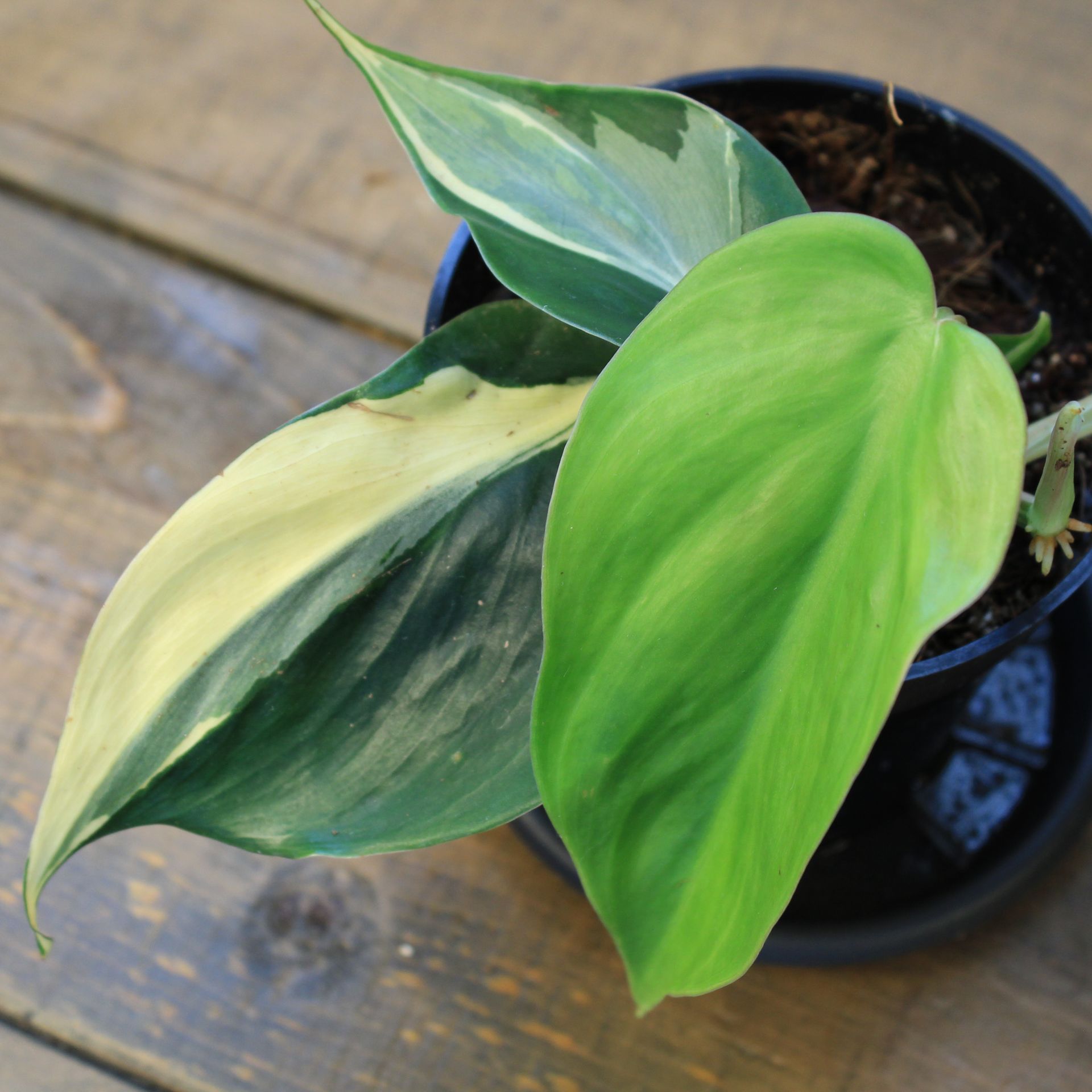
It’s not sudden. It’s gradual.
The first leaves were well-defined. The light stripe was crisp.
Then, gradually, the new leaves began to show: a narrower stripe, less contrast, more dominant green.
Nothing alarming at first. But once again, it’s the trends that matter.
Why I’m Waiting Before Cutting
In the case of the Rio, I don’t cut immediately. Why? Because the mutation is still clearly present. It’s weakening, but it hasn’t disappeared.
Cutting too early could: unnecessarily weaken the plant, interrupt still-viable growth, or cause unnecessary stress
What This Case Illustrates
Reversion isn’t always dramatic. Sometimes, it’s a slow drift.
And in those cases, patience is part of the strategy. Not every intervention needs to be immediate.
Understanding the plant’s rhythm is just as important as understanding the mutation itself.
Why Do Plants Revert?
Variegation is a mutation. And like any mutation, it requires balance.
The white or cream areas of a leaf contain little to no chlorophyll. They’re aesthetic… but energetically costly.
If the plant lacks light, experiences stress, or simply seeks to optimize its growth, it may produce more green tissue.
More green = more chlorophyll. More chlorophyll = more energy. Reversion isn’t a flaw. It’s a survival strategy.
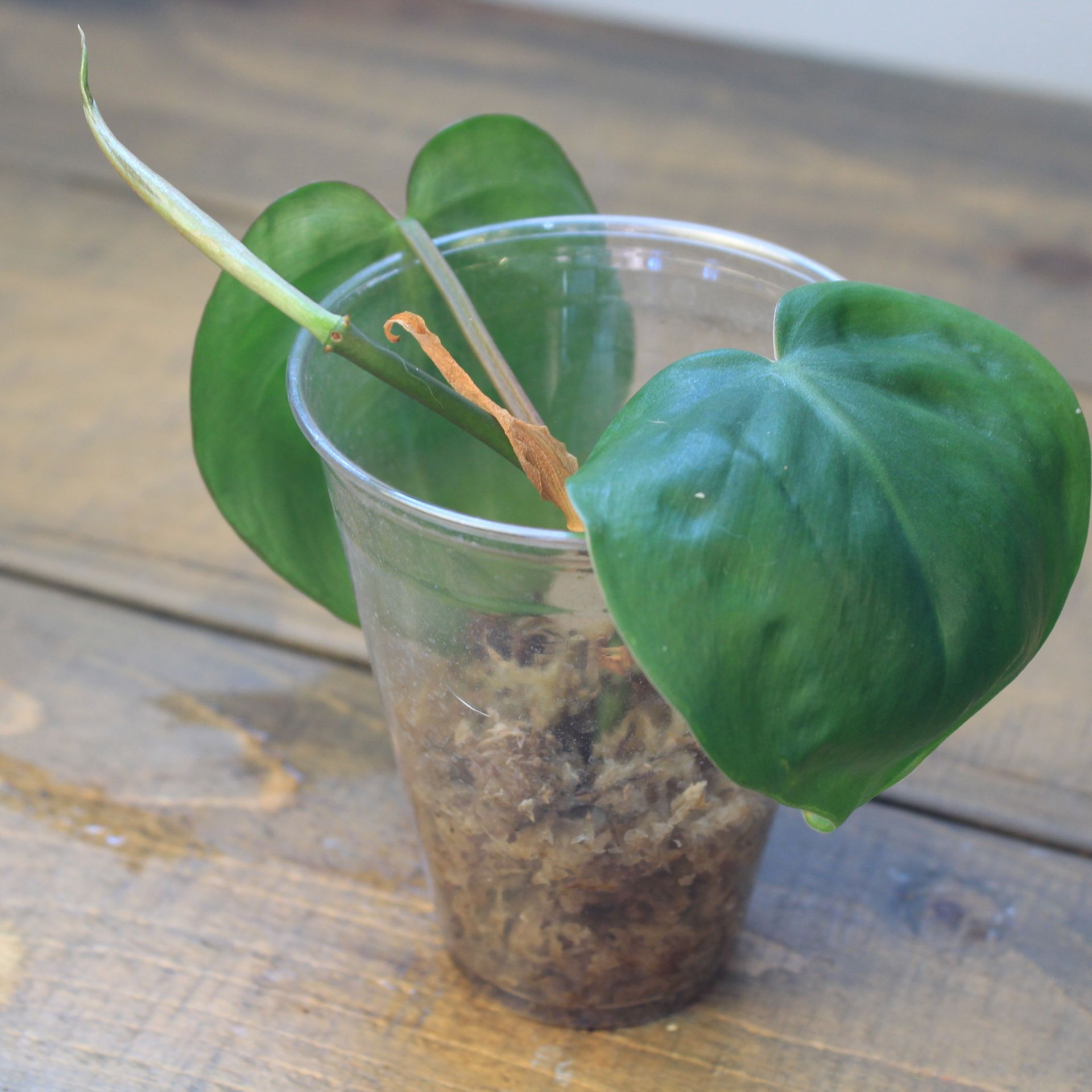
Conversely, a plant can also produce a leaf that is almost entirely white. It’s spectacular, but if the structure no longer contains enough green tissue, the balance becomes fragile.
Variegation is therefore a constant compromise. A balancing act between aesthetics and efficiency. And that’s exactly what makes it so fascinating.
Conclusion — Observe Before Acting
Variegation isn’t fixed. It evolves. It adjusts. It responds to its environment.
A plant can revert to green. It can produce an entirely white leaf. It can rebalance itself after a strategic cut.
Nothing is permanent. And that’s exactly what makes it so captivating.
Understanding variegation isn’t just about appreciating a beautiful leaf. It’s about learning to read a stem. To recognize a trend. To decide when to intervene… and when to wait.
At LFAP, we don’t just grow rare plants. We cultivate observation. Patience. And sometimes, the courage to bring out the cutter.
Because a plant isn’t trying to be perfect. It’s trying to survive. And once you understand that, you’ll never see variegation the same way again.